
6 Ways Self-Directed IRA Investors Can Lower Their Tax Bill Before Year-End
Key Takeaways
Illiquid assets take longer to move, so start early to meet December 31 deadlines.
Converting an illiquid asset while its value is lower, such as a property mid-renovation, can reduce taxes on a Roth conversion.
A large conversion can push your income past the new limits on the SALT and senior deductions.
If one IRA holds cash and another holds property, you can take both RMDs from the cash account.
Few things in finance sting as much as learning you missed your chance to get a tax break. You can do everything right and still wind up paying more than you had to.
By the time you hand the K-1s and 1099-Rs to your CPA, the window for many decisions that could have lowered your tax bill has closed. Most year-end tax advice assumes you hold stocks and funds, where a few clicks can solve your problems.
But if you have a self-directed IRA holding alternative assets, your checklist looks a bit different. A rental property, a private note, and a syndication interest each come with their own valuations, cash flow, and paperwork. Planning has to start earlier because executing takes longer.
Investor Year-End Deadlines Vary
Some investors rush to fund an IRA they’ve had months to fund. Others wait until April, not realizing the opportunity passed months ago. These deadlines mean completing the transaction or strategy, so plan for processing time.
Here are the key deadlines to know.
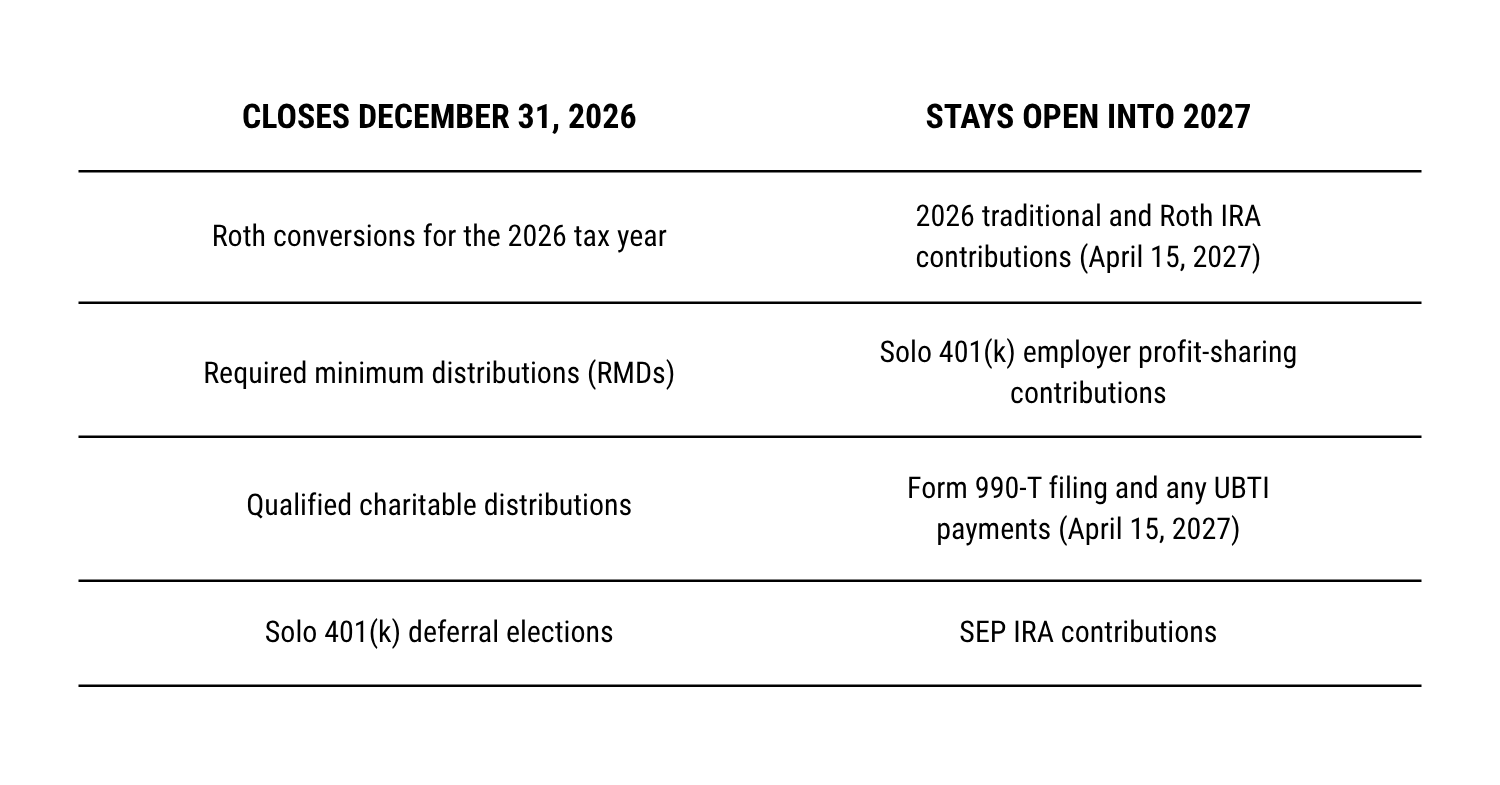
With illiquid assets, complete means a defensible valuation, a signed instruction, and enough time for your custodian to process both.
6 SDIRA Strategies to Reduce Your Tax Bill
If you invest through a self-directed IRA, these six year-end SDIRA tax strategies can lower your tax bill. You must complete all six by December 31.
1. Convert at a Defensible Valuation and Pay Less Tax on the Same Asset
Say your IRA holds a duplex in the middle of a full-gut rehab. Once it’s finished and leased, it may appraise at $400,000. Today, with no tenants and a torn-up kitchen, a defensible value might be $340,000. If you made a Roth conversion now, you would pay tax on $60,000 less.
In the 32% tax bracket, that shakes out to about $19,200 in savings. Converting at that present value moves the same asset for less tax, and then everything it earns afterward grows tax-free.
I’ve read enough appraisals to know they’re just a matter of professional opinion. Yours has to be independent and well documented. “Trust, but verify” applies to your own numbers as much as anyone else’s.
The same goes for estimates from an AI algorithm on a real estate website. They usually price off nearby sales, but they can’t account for your property's specific condition.
2. Size the Conversion Before It Costs You Two Deductions
The usual advice is to convert as much as possible under today’s rates. I say size matters more than speed.
A conversion raises your modified adjusted gross income, and two provisions of the One Big Beautiful Bill Act hinge on that number. For 2026, the state and local tax deduction caps at $40,400 and drops 30 cents for every dollar of MAGI above $505,000 (bottoming out at $10,000). The $6,000 senior deduction for taxpayers 65 and up shrinks by 6% of MAGI above $75,000 for a single filer and $150,000 for joint filers.
A conversion that’s too large, then, can diminish or eliminate those deductions in the year you make it. Your CPA can help you size the conversion.
3. Cover Your SDIRA’s RMD From a Liquid IRA and Avoid a Forced Sale
Say you have two traditional IRAs: one holds a brokerage portfolio with cash to spare, while the other holds illiquid assets, like rental properties. The IRS lets you calculate the required minimum distribution for each, add them together, and pull the full amount from either account. The brokerage IRA can pay out both, so you don’t have to touch your rental.
Most of my clients prefer to keep a cash reserve inside their self-directed account, and aggregation is the backstop when reserves run thin. Employer plans don’t work this way, so map each account before you decide where the money comes from.
Should you miss the December 31 deadline, the shortfall comes with a 25% excise tax (reduced to 10% if you correct it within two years).
4. Send the RMD to Charity and Keep the Income Off Your Return
If you’re 70½ or older, a qualified charitable distribution moves up to $111,000 per person (2026) straight from your IRA to a qualifying charity. The amount counts toward your RMD if you haven’t satisfied it this year. It stays out of your taxable income (which helps you stay under the lines mentioned in strategy two).
The transfer must go directly from the IRA to the charity without passing through your hands. If you take the cash first, the exclusion disappears.
5. Pay the IRA’s Deductible Expenses Before December 31
If your IRA holds leveraged real estate or an operating partnership, it can owe tax on its own. Once gross unrelated business income reaches $1,000, the account needs its own EIN, files Form 990-T, and pays tax at trust rates from its own funds.
Expenses tied to that income reduce it in the year the IRA pays them. Covering your IRA’s property tax bill from a personal account is a prohibited transaction, and the IRS would treat the entire IRA as distributed on January 1 of that year. You would owe income tax on the full balance.
6. Elect Your Solo 401(k) Deferral Before 2027
If you’re self-employed, a Solo 401(k) can take up to $72,000 in contributions for 2026 (plus catch-up contributions after age 50). The employer contribution can wait until you file. For most business types, though, the plan has to exist, and your deferral election must be in writing by December 31. Sole proprietors opening their first plan get extra time under SECURE 2.0. Pre-tax deferrals into this retirement account reduce your 2026 taxable income dollar for dollar.
FURTHER READING: Consultants and Firm Owners: The Solo 401(k) Advantage for Alternative Investments
How Chicago Trust Administration Services Can Help
Every strategy here starts with a conversation with your CPA. The second conversation is with your SDIRA administrator, and that’s who we are. At Chicago Trust Administration Services, we’re not financial advisors or tax preparers. We’ll never tell you whether to convert or how much. We handle the valuations, transfers, distributions, and documentation that go with your decisions.
To talk through your valuations, RMD timing, or possible Roth conversions, we invite you to schedule a complimentary meeting with us by calling 312-869-9394 or emailing steve@ctasira.com.
Frequently Asked Questions (FAQs)
Q: Can I harvest tax losses inside my self-directed IRA?
A: No. Gains and losses inside an IRA don’t affect your personal return, so selling a losing position won’t help at tax time.
Q: Can I take my RMD as a piece of the property instead of selling it?
A: Yes. An in-kind distribution moves a share of the asset, such as a percentage interest in a rental, out of your IRA and into your name. You will owe tax on that share’s fair market value, so you’ll need cash from somewhere to cover it.
Q: I’m past 73 and still working. Does that delay my RMD?
A: Not for an IRA. The still-working exception applies only to certain employer plans, and only if you own 5% or less of the business.
*The content and opinions in this material are for general information only and are not intended to provide specific advice or recommendations for any individual.
**CTAS professionals are not financial advisors and cannot provide advice or recommendations regarding specific investment decisions.