
How Self-Directed IRAs Help Gen X Catch Up on Retirement Savings Fast
Key Takeaways
A higher contribution limit alone won't close a retirement gap. The assets that money is invested in are what shift the outcome.
Whether you're on an employer 401(k) or running your own business, the same alternative asset strategy can compress a 10-year runway that traditional investing can't.
Consolidating old retirement accounts often puts more capital to work faster than new contributions alone.
Business owners without full-time employees other than themselves and a spouse have an even higher contribution ceiling through a solo 401(k).
You're in your late 40s, 50s, maybe your early 60s. By most measures, you're doing well. A steady career and a leadership role, or a business you built from scratch and a book of clients you've earned over decades.
But retirement isn't that far off, and the numbers aren't reassuring.
I've had this conversation with more Gen X clients over the past few years than any other generation. Most of them were disciplined from start to finish, but timing was working against them.
The dot-com collapse hit early in their careers. The 2008 Great Recession hit again, right in their prime earning years. Then the pandemic disrupted business income and corporate plans alike, just as they were ready to catch up.
Layer that over a retirement system that has shifted the entire burden of saving onto the individual, whether that meant trading a pension for a 401(k) as an employee, or building a plan from scratch as a business owner from day one, and even people who did most things right end up with a real gap.
How can Gen X hope to catch up?
The IRA and 401(k) Contribution Math for 2026
Contribution limits break down by account type and age, and the differences between them are bigger than you might expect.
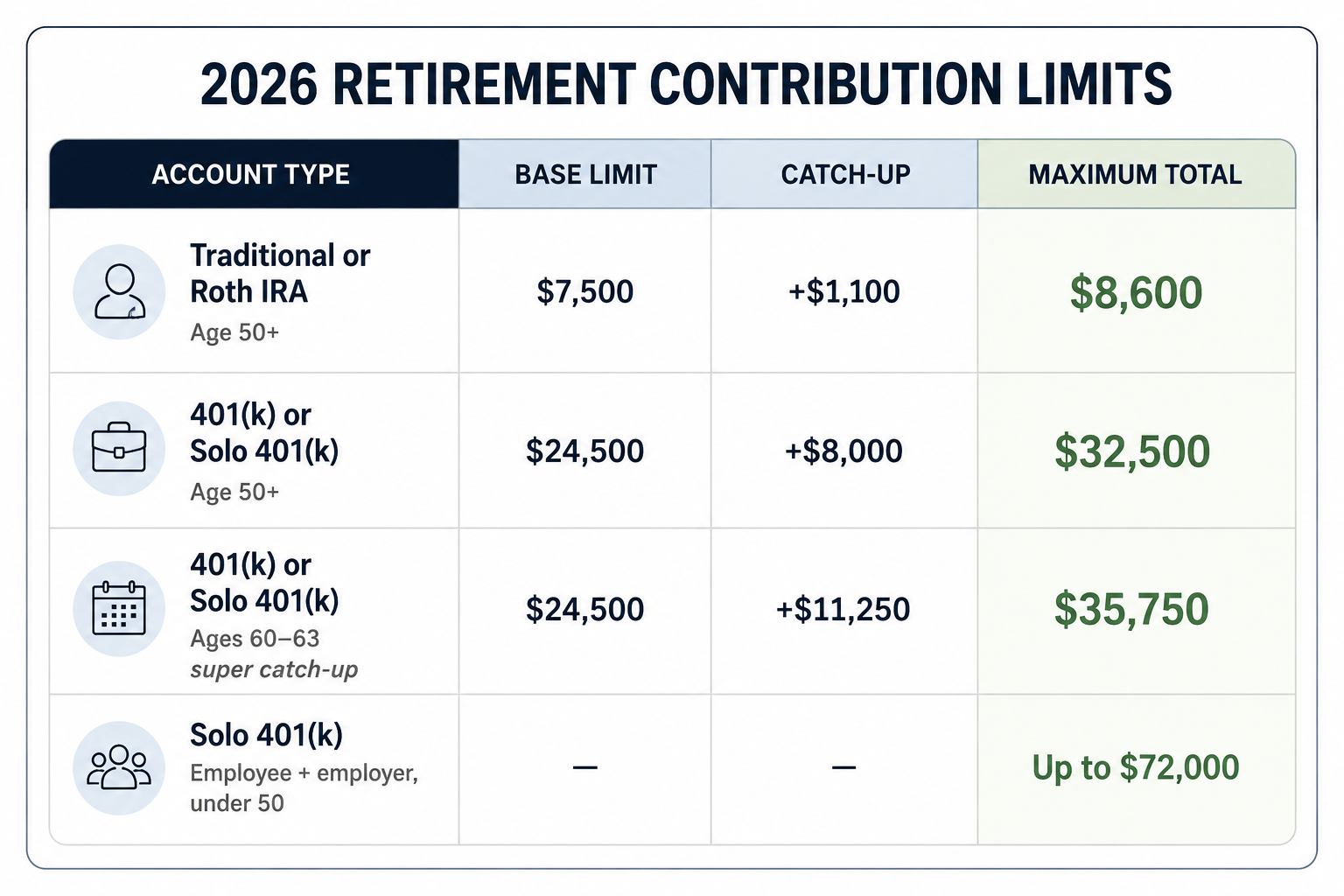
If you own your business, whether you take draws, distributions, or pay yourself a W-2 salary through an S-corp or C-corp, and you don't have full-time employees other than yourself and a spouse, that last row is where the real opportunity sits.
We break down exactly how to structure a solo 401(k) to reach that ceiling in this article. For the rest of this piece, we'll focus on the strategy that applies whether someone else's company employs you or you own the business yourself.
Those figures cap what you're allowed to contribute, but they don't determine what that money is allowed to buy.
How Alternative Assets Can Compress a 10-Year Timeline
Maximizing contributions into the same mutual fund lineup you've held for twenty years won't close a decade-sized gap.
A 10-year runway to retirement doesn't give anyone the same room as a 30-year runway. You don't have time to ride out a lost decade in the market and still come out ahead.
What you do have is capital, professional experience, and often direct access to deals your younger peers don't see yet:
Rental properties in markets you already understand
Private lending opportunities through your own professional network
A syndication led by someone whose track record you can verify firsthand
A self-directed IRA or 401(k), solo or employer-sponsored, is the account structure that lets your retirement dollars participate in any of those opportunities.
A traditional custodian won't hold a rental property, a promissory note, or an interest in a private company. A self-directed account will, provided everything is documented and held to the same IRS rules as any other retirement account.
Rental real estate held for cash flow works like an annuity, but a much better one: no giving up principal, income year over year, and it can pass directly to your heirs.
Private lending and syndications carry different risk and liquidity profiles, and none of these assets are guaranteed. But they don't move in lockstep with the stock market, and the income they generate compounds inside your account, tax-deferred or tax-free, depending on the structure.
What About AI?
A lot of the retirement guidance available to a Gen X investor today comes from automated tools: robo-advisors, algorithmic rebalancing, and AI-generated retirement calculators.
Those tools can optimize a generic portfolio for someone your age and income, but they can't structure an account to hold the specific deal sitting in front of you right now.
AI-powered investing has its place, but urgent, intentional self-directed investing still demands a human touch.
A Realistic 10-Year SDIRA Strategy
Step 1: Max out every catch-up contribution available to you. If you own your business and don't have full-time employees other than yourself and a spouse, a solo 401(k) usually gets you toward that $72,000 ceiling faster than a SEP or Traditional IRA, regardless of whether you pay yourself through draws, distributions, or a W-2 salary.
If you're employed by someone else's company, max your catch-up on their 401(k) plan ($32,500 total, or $35,750 if you're between 60 and 63), then add a full Traditional or Roth IRA catch-up on top through a separate account.
Step 2: Consolidate old accounts. Most Gen X investors, self-employed or not, have a 401(k) or two sitting with a former employer, or an old SEP-IRA from an earlier stage of their business.
Rolling those into a self-directed structure through a direct custodian-to-custodian transfer isn't a taxable event, and it puts that capital to work now rather than waiting on new contributions.
Step 3: Prioritize income over appreciation. With ten years instead of thirty, cash-flowing assets, rental income, and note payments can generate usable income you can reinvest right away.
Step 4: Use Roth catch-up contributions or conversions where you qualify. Paying tax now on a decade of alternative asset growth is a very different proposition than paying tax on thirty years of it. Run the numbers with your tax professional before you decide.
Step 5: Get the compliance foundation right. Disqualified persons, prohibited transactions, and arm's-length requirements don't bend for a shorter timeline, and they apply the same way whether your account is a solo 401(k) or a rollover IRA. A mistake here costs you time you don't have to spare.
Every step demands due diligence. It always makes for a better investment, regardless of how much time you have left. A shorter runway means there's no room to waste on mistakes.
Vet the sponsor, verify the collateral, and read the offering documents yourself before moving capital. The custodian's job is only to make sure the account and the transaction are structured correctly, nothing more.
How Chicago Trust Administration Services Can Help
If you're a Gen X professional running these numbers for the first time or the tenth, whether you're consolidating a stack of old 401(k)s from a career spent working for other companies or evaluating a solo 401(k) for the business you own, we can help you determine whether your current account can hold the alternative assets you want, such as real estate, private lending, and syndications.
To see how we can help, we invite you to schedule a complimentary meeting with us by calling 312-869-9394 or emailing steve@ctasira.com.
Frequently Asked Questions (FAQs)
Q: Does the age 60-63 super catch-up apply to my IRA, too, or only my 401(k)?
A: Only employer-sponsored plans qualify: 401(k), 403(b), governmental 457 plans, the Thrift Savings Plan, and solo 401(k)s. The IRA catch-up stays at $1,100 for 2026 regardless of age once you're 50 or older.
Q: I work for someone else's company. Can I still use an alternative asset strategy?
A: Yes. The solo 401(k) is only available to business owners without full-time employees other than themselves and a spouse, but a self-directed IRA is open to anyone, and old 401(k)s or IRAs from previous employers can be rolled into one through a direct, non-taxable transfer. Consolidating existing capital is often the bigger lever, regardless of how your income is structured today.
Q: I own my business, but I pay myself a W-2 salary through my S-corp. Does that disqualify me from a solo 401(k)?
A: No. Solo 401(k) eligibility comes down to ownership and headcount, not whether your income shows up on a W-2 or a 1099. As long as your business has no full-time employees other than you and a spouse, paying yourself a W-2 salary doesn't change your eligibility.
Q: I don't have $30,000 or more a year to contribute. Is a 10-year SDIRA strategy still worth pursuing?
A: Yes. Maximizing every catch-up dollar helps, but the bigger opportunity for most Gen X investors is redirecting capital already sitting in old 401(k)s and IRAs into a structure that can hold alternative assets. New contributions and consolidated capital work together.
Q: What happens to my catch-up contributions if I earned over $150,000 last year
A: Under a SECURE 2.0 rule that took effect for 2026, if your FICA wages exceeded $150,000 in 2025, any 401(k) catch-up contribution you make in 2026 must go in as a Roth, after-tax contribution rather than pre-tax. This rule applies to employer plans and doesn't affect self-employed individuals without FICA wages the same way. Talk to your plan administrator and tax professional about how it affects your specific situation.