
Private Credit in Your SDIRA? What to Know Before You Invest
Key Takeaways
Private credit and private lending are related but structurally different investments that influence your SDIRA’s documentation requirements and compliance exposure.
Private lending names your SDIRA as the direct lender of record on a single note, while private credit typically means holding a limited partnership interest in a fund managing many loans at once.
Investing through a private credit fund introduces compliance risks, including UDFI from fund-level leverage and disqualified-person exposure in closely held vehicles.
Private credit, once a specialized institutional strategy, is increasingly coming up in conversation with SDIRA investors. As credit managers shift to increase access for individual investors, you may wonder if private credit belongs in your account.
I’m here to help you understand what it is, the risks you’d be taking on, and the compliance piece that comes with any self-directed IRA asset.
Isn’t Private Credit Just Private Lending?
Private lending has been available within a self-directed IRA for as long as I’ve been doing this. Private credit, though, is newer to the conversation, at least for individual investors. While the two sound similar and overlap, they’re distinct.
Private lending refers to transactions in which a non-bank or individual lends money directly to a borrower under a private, custom agreement. As a strategy, it falls under the “private credit” umbrella.
Private credit is the broader institutionalized asset class (also called private debt) that includes standard direct lending, mezzanine debt, distressed debt, asset-based lending, and structured credit.
(The differences between these mostly come down to what happens if a borrower can't pay, not whether you get paid at all)
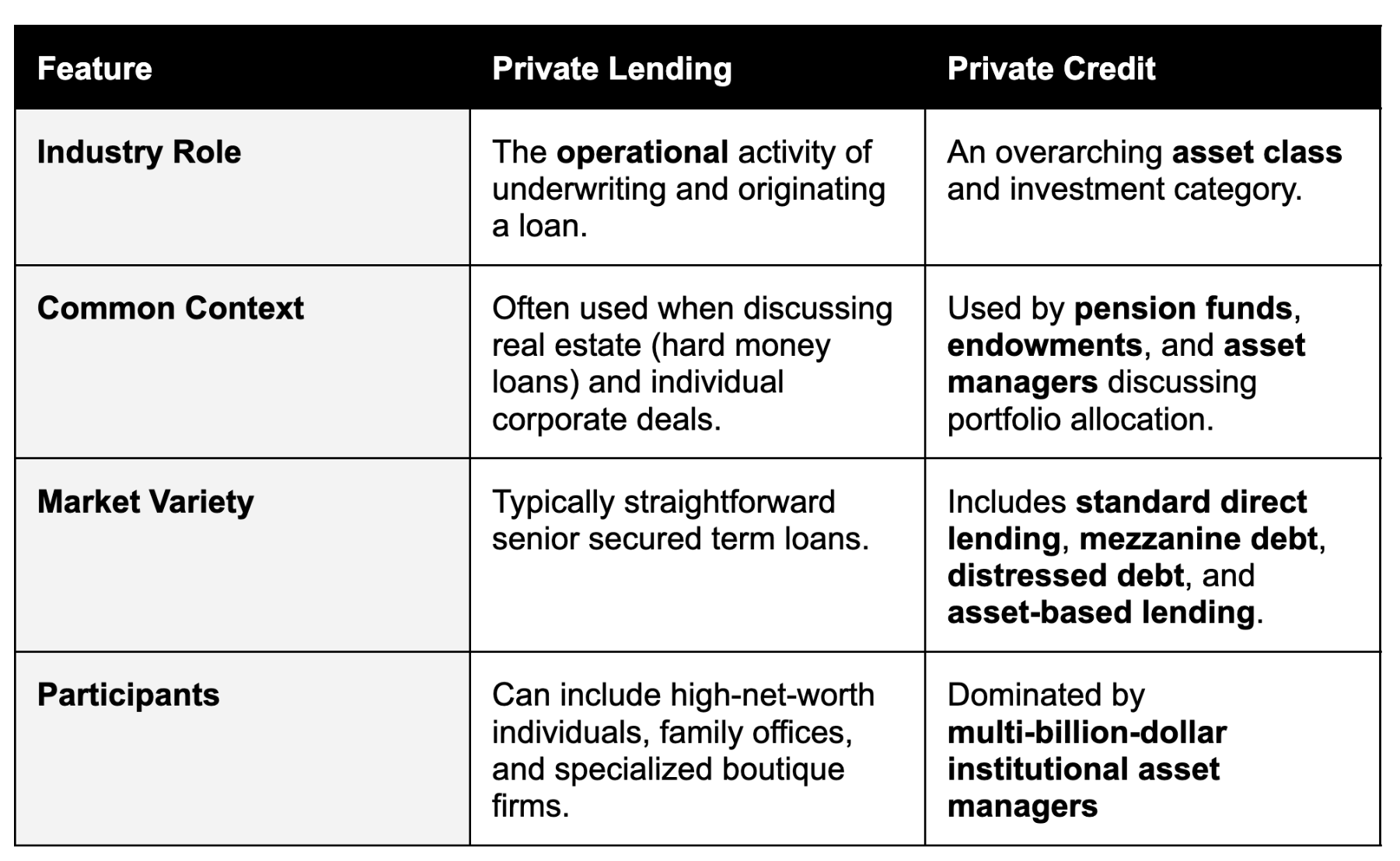
For your SDIRA, that distinction plays out in three practical ways:
Who you’re relying on. With a direct note, you or your deal sponsor chose the borrower and negotiated the terms. With a private credit fund, you’re relying on a manager’s underwriting across every loan in the portfolio.
What you own. A direct note is titled to your SDIRA and secured by a specific asset. A fund investment is a limited partnership interest, valued periodically by the manager rather than priced against a deal you can inspect yourself.
How risk is distributed. A direct note concentrates risk in a single borrower. A fund diversifies across many loans, which can reduce single-borrower exposure with the trade-off of manager risk and less visibility than in an individual deal.
Investors get into trouble when they approach a private credit fund as if it is just private lending on a larger scale.
So Why Is Private Credit Suddenly a Part of the SDIRA Conversation?
Institutional demand for private credit has been maturing for years, but as returns on established strategies have compressed, fund managers have turned to individual investors for new growth capital.
Since around 2021, and accelerating over the last year or two in particular, several of the country's largest private credit managers (firms like Blackstone, Blue Owl, and KKR) have launched interval funds, non-traded business development companies, and evergreen vehicles designed to increase access for individual investors. Entry points once required minimum million-dollar commitments — today, the minimum initial investment for Blackstone's Private Credit Fund (BCRED) is just $2,500.
For SDIRA investors, the “why now” is simple: structures once geared primarily toward large institutional investors have become increasingly accessible to individual investors.
I approach it with the same skepticism I bring to any asset class that surges in popularity. Lower minimums and quarterly redemption windows don’t eliminate illiquidity risk.
2 Areas Where Fund-Based Private Credit Creates Compliance Risk
1. Fund-Level Leverage and UDFI
Private credit funds may use leverage to boost their own returns. Leverage is allocated pro rata to every limited partner (including your IRA) and can trigger Unrelated Debt-Financed Income on the portion of your returns tied to that debt. Interest income is usually clean inside an IRA, but not when the fund itself is leveraged.
That’s why I encourage my clients to review a fund’s private placement memorandum for its leverage policy before assuming a fixed-income label means UBTI-free.
2. Disqualified Persons Inside Closely Held Funds
With large, diversified institutional funds, disqualified-person risk is minimal. After all, your IRA is one of hundreds of investors with no relationship to the underlying borrowers. The risk grows with smaller, closely held credit funds like those where a business partner, family member, or anyone else with a stake in your affairs holds meaningful ownership.
The overlap can turn a passive fund investment into a prohibited transaction under the disqualified-person rules that apply to self-directed IRAs.
Documentation Follows the Structure You Choose
For a direct note: you need a promissory note, a security agreement (if the loan is collateralized), and title naming your SDIRA as lender of record.
For a fund investment: you’re working with subscription documents and a private placement memorandum. The fund reports your income on a K-1 instead of a 1099-INT.
Capital calls can arrive with just days’ notice, which is where a boutique custodian comes in. If your account isn’t already set up and funded, you risk missing the opportunity.
How Chicago Trust Administration Services Can Help
At Chicago Trust Administration Services, we’re not financial advisors making investment recommendations. We don't evaluate credit quality or underwrite a fund’s loan book. Instead, I make sure the structure holds up under scrutiny: your SDIRA is properly titled as lender of record on a direct note, subscription paperwork and income reporting are confirmed, and account liquidity is in place before a fund’s capital call deadline.
Ultimately, deals go smoothly because the account was built correctly from the beginning. To see how we can help, we invite you to schedule a complimentary meeting with us by calling 312-869-9394 or emailing steve@ctasira.com.
Frequently Asked Questions (FAQs)
Q: How is the value of a private credit investment reported for your SDIRA's annual IRS filing?
A: Every asset in your SDIRA needs a fair market value reported annually on IRS Form 5498. For a fund investment, custodians typically rely on the valuation the fund manager provides through a periodic NAV statement. For a direct note, valuation is usually based on outstanding principal. Either way, you'll need to supply documentation supporting the reported value.
Q: Do I need to be an accredited investor to put SDIRA funds into a private credit fund?
A: Many private credit funds require accredited investor or qualified purchaser status, verified based on your personal income or net worth. Securities law sets this fund-level requirement.
Q: How liquid are private credit investments inside an SDIRA?
A: Some newer funds offer semi-liquid structures with quarterly redemption windows, while others lock up capital for several years. Either way, factor that timeline into your required minimum distribution planning well before deadlines.
*The content and opinions in this material are for general information only and are not intended to provide specific advice or recommendations for any individual.
**CTAS professionals are not financial advisors and cannot provide advice or recommendations regarding specific investment decisions.