
Checkbook Control IRA: Is Speed Worth the Extra Responsibility?
Key Takeaways
Checkbook control lets you sign checks for an LLC your IRA owns, as long as the entity is newly formed, you aren't compensated, and no disqualified persons are involved.
Every prohibited transaction rule still applies inside the LLC.
When you hold the checkbook, you take over the compliance responsibilities your custodian would normally handle.
A checkbook control IRA tends to fit investors who make frequent, smaller transactions rather than a few large purchases each year.
The seller wants earnest money by Friday, but you’re waiting on someone else. You know this could be a promising investment opportunity, but investing through a self-directed IRA means routing every payment through a custodian for processing.
The delay is stressful enough, but missing a deal because of it is even more frustrating. If you’re a business owner or executive who's spent decades signing your own checks, asking for permission to spend money you control feels backward.
Checkbook control claims to fix that problem. Your IRA owns an LLC, and you sign the checks as its manager.
After over 30 years in this industry, I’d ask you to weigh one thing before you form that LLC. When you take control of the checkbook, you also take over the compliance reviews your custodian performed for every transaction.
How Does Checkbook Control Work in a Self-Directed IRA LLC?
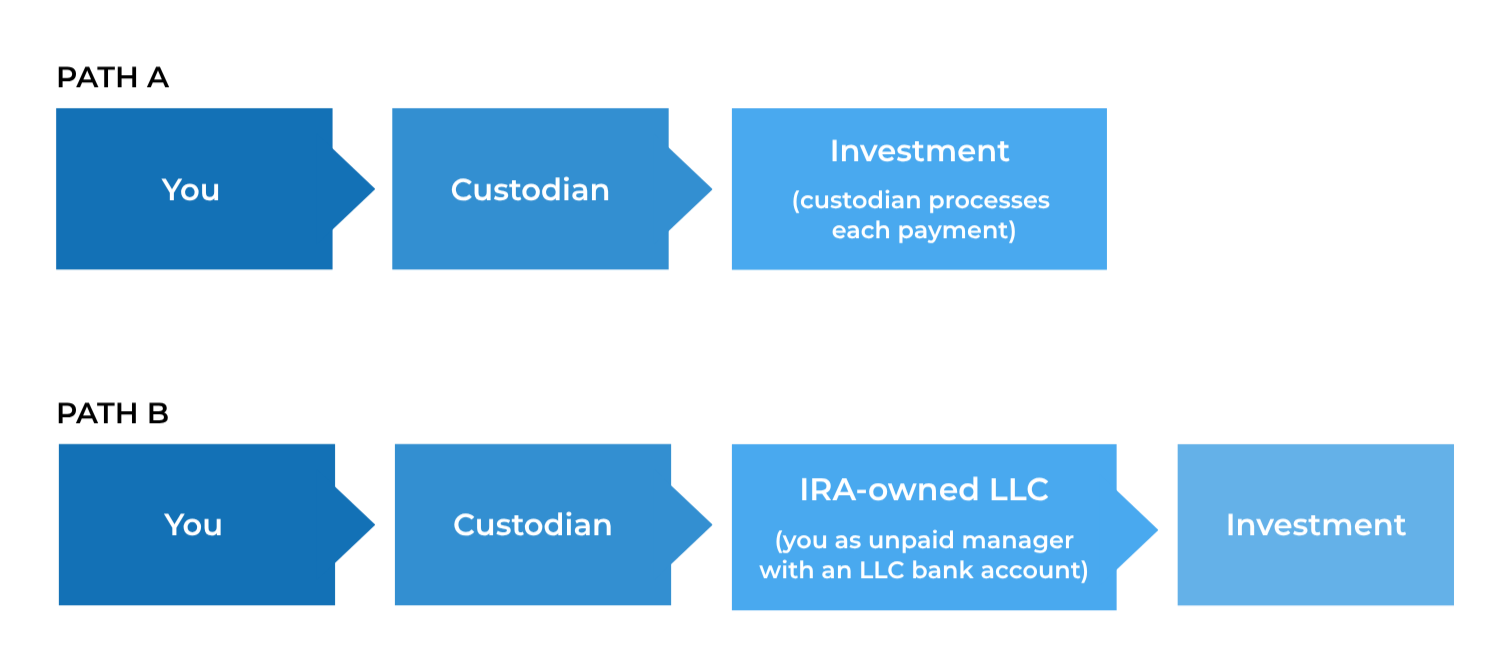
A checkbook control IRA (sometimes called a self-directed IRA LLC) generally forms in four steps:
You open and fund a self-directed IRA with a custodian.
You form a new LLC, and your IRA buys its membership interest with IRA funds.
The operating agreement names you as manager, and the LLC opens a bank account under its own EIN.
You invest the LLC’s money by writing checks or sending wires from that account.
From that point on, your custodian holds the LLC interest, and the LLC holds the investments.
If you’re at all familiar with self-directed IRAs, you may think this sounds like a loophole. This approach is grounded in Swanson v. Commissioner (1996). The Tax Court found no prohibited transaction in an IRA buying newly issued stock in a company the IRA owner had just formed, because a company with no owners yet isn’t a disqualified person.
The court also found that Swanson’s unpaid service as a director didn’t violate the rules. The ruling hinged on the fact that the entity was newly formed and the owner took no compensation from it.
Prohibited Transaction Rules Still Apply
Nothing about a checkbook control IRA changes the IRS rules that govern what your self-directed IRA can and can’t do.
Disqualified persons still include you, your spouse, your parents/grandparents, your children/grandchildren (and their spouses), your IRA’s fiduciaries, and any business disqualified persons own 50% or more of.
The LLC can’t buy from, sell to, lend to, or pay any of them. It also can’t let them use its property. (We cover these rules in more detail in this article.)
If you or a beneficiary engage in a prohibited transaction, the IRS disqualifies the account as of January 1 of that year. The full balance becomes immediately taxable
In Ellis v. Commissioner, Terry Ellis rolled 401(k) funds into a self-directed IRA. The IRA bought 98% of a newly formed LLC that ran a used car business. Ellis served as general manager and had the LLC pay him a salary.
Although he argued the money came from the LLC’s account, not the IRA, the Tax Court rejected that argument in 2013. The Eighth Circuit agreed in 2015, so Ellis lost the IRA’s tax-deferred status.
Similarly, in Peek v. Commissioner (2013), two investors used their IRAs to buy a business through a newly formed corporation. They then personally guaranteed a loan the corporation took on. The Tax Court ruled each guarantee an indirect extension of credit to the IRA. Both IRAs lost their tax-advantaged status
Personal guarantees may be routine in conventional lending, but any loan an IRA-owned LLC takes on needs to be non-recourse.
When You Hold the Checkbook, You’re the Compliance Department
Normally, your IRA custodian processes each disbursement, and someone reviews the transactions before money moves. With a checkbook LLC, you become that checkpoint. In practice, that means:
Keeping the LLC’s bank account clean. Sales proceeds and rent go in; property expenses go out. Zero personal money gets involved.
Screening every counterparty. Before the LLC buys property or hires contractors, you confirm no disqualified persons are involved.
Staying hands-off. Though you can make decisions as an unpaid manager, you cannot pay yourself or do repair work on property the LLC owns.
Supplying a value every year. Your custodian must report the fair market value of LLC interests to the IRS. The records you keep affect how accurate that number is.
These added responsibilities give the IRS reason to watch closely. The IRS has noted that the risk of a prohibited transaction rises when an IRA owner controls the investments inside the account, as with a checkbook LLC.
You can get that control in an afternoon, since AI tools and online formation services can set up an LLC and draft operating agreements quickly. While that lowers setup costs, IRS and court standards don’t change.
In my experience, checkbook control better suits investors who make frequent, smaller transactions. For investors who make only a few larger purchases each year, such as a rental property or a stake in a syndication, checkbook control is less compelling.
Whichever structure you choose, decide in coordination with your attorney and tax advisor.
How Chicago Trust Administration Services Can Help
If speed is your main concern, ask how quickly your custodian moves. At Chicago Trust Administration Services, we open accounts and fund asset purchases in 7 to 14 days. Moving funds from your existing plan takes up most of that time.
We help investors understand what each structure requires before committing capital. If you already run an IRA-owned LLC, we can review how it operates.
To see how we can help, we invite you to schedule a complimentary meeting with us by calling 312-869-9394 or emailing steve@ctasira.com.
Frequently Asked Questions (FAQs)
Q: Can I move an LLC I already own into my self-directed IRA?
A: No. You’re a disqualified person, so selling your LLC interest to your IRA is a prohibited transaction regardless of how much of the company you own. If you own 50% or more, the LLC itself is also a disqualified person, so your IRA can’t do business with it either. Outside of rollovers, IRA contributions also have to be made in cash.
Q: Does an IRA-owned LLC pay income tax?
A: The IRS generally disregards a single-member LLC owned by your IRA for federal tax purposes, so its income flows to the IRA tax-deferred (or tax-free in a qualifying Roth).
The exception is unrelated business taxable income, which can come from operating a business or from debt-financed property (such as a rental bought with a non-recourse loan). If the IRA has $1,000 or more of gross unrelated business income in a year, it must file Form 990-T and pay tax from IRA funds.
*The content and opinions in this material are for general information only and are not intended to provide specific advice or recommendations for any individual.
**CTAS professionals are not financial advisors and cannot provide advice or recommendations regarding specific investment decisions.